

In this article
What does an options chain show?
An options chain organizes contracts by expiry and strike, often placing calls and puts on opposite sides. Each quote belongs to one option type and contract. Rows can also show implied volatility, sensitivities, open interest and trading volume.
In a crypto options chain, units need particular attention. The strike can be displayed in USD while a premium or quantity uses another unit. Read the field definition before treating two displayed numbers as directly comparable.
Choose the underlying and expiry first. Locate the strike, then confirm whether you are reading a call or a put. Keep this identity in view when moving from a row into a contract detail.
Read bid, ask and last trade as separate observations
The bid and ask are quoted prices on the buying and selling sides. The last trade is a reported execution, potentially from an earlier time. A last-trade value cannot fill a missing side of the current quote without changing the meaning of the calculation.
Check the source and time associated with these fields. If quote sizes are available, read them with the prices. A displayed price by itself does not state the quantity available at that level, and none of these fields guarantees a future fill.
For a concrete field reference, Deribit distinguishes best prices, last price, mark price and order-book timestamp. Its definitions apply to its own data; they do not make every venue’s similarly named field interchangeable.
Worked example: bid 100, ask 120
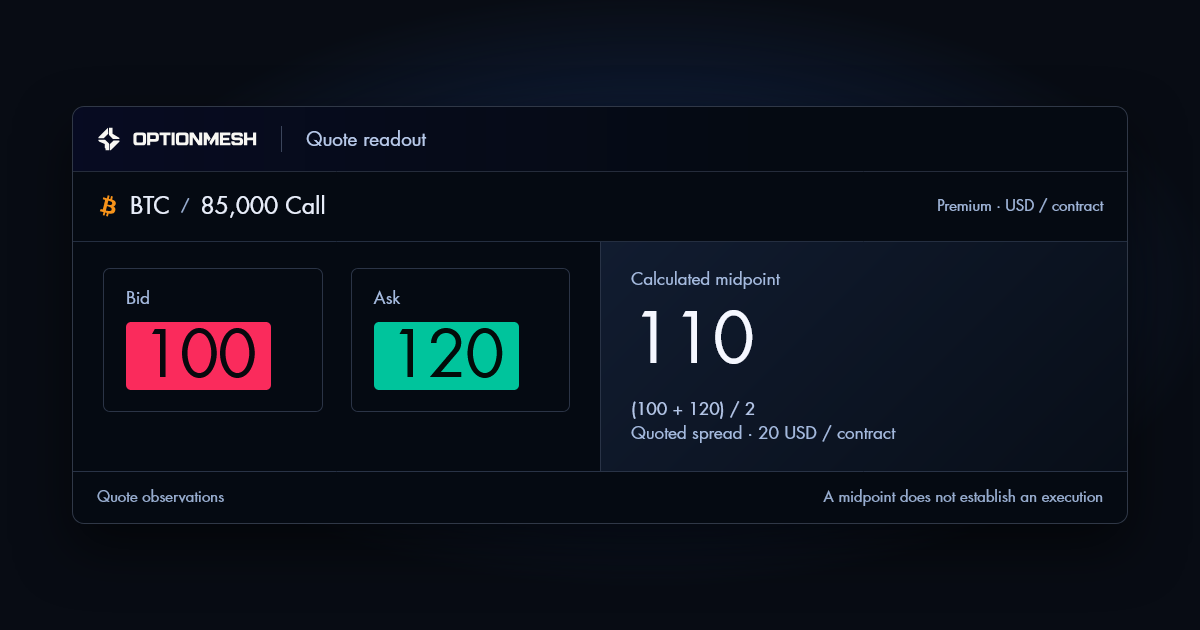
Assume one synthetic contract has a bid of 100 and an ask of 120, both in USD per contract. Its midpoint is (100 + 120) / 2 = 110. The quoted spread is 120 − 100 = 20, in the same premium unit.
| Field | Value |
|---|---|
| Bid | 100 |
| Ask | 120 |
| Calculated midpoint | 110 |
| Quoted spread | 20 |
The calculation uses the two displayed sides and assumes they belong to the same quote context. It does not establish that a trade occurred at 110 or that an order would execute there.
If the ask is unavailable, leave this two-sided midpoint and spread unavailable as well. A missing value is different from an explicit zero. If a bid exceeds an ask, investigate timestamps, sources and units before using the crossed quote.
Separate open interest from volume
Open interest describes outstanding contracts or their reported quantity equivalent. Volume describes traded quantity over a specified window. To compare either field across venues, establish the unit and the period attached to it.
A volume figure does not tell you how much of that trading opened new positions. Public open interest also does not identify the buyer, seller or dealer inventory. OIC’s explanation of open interest and volume illustrates this distinction for listed options; crypto venue reporting rules still need checking separately.
When examining a busy row, ask whether you are looking at a large outstanding quantity, a large amount traded during the window, or a tight current quote. Those observations answer different questions.
Read IV and Greeks with their calculation context
Implied volatility is inferred from an option price through a pricing model. Different price inputs and conventions can produce different IV readings. A mark-based IV, a bid IV and an ask IV should retain their labels.
Greeks describe model sensitivities. A Delta or Gamma value needs the selected contract, unit and convention. When comparing sources, check whether the values are supplied by the venue or calculated elsewhere, and whether the inputs refer to comparable times.
To examine the shape of IV across strikes or expiries, move to a volatility view while keeping the chosen expiry and reference clear. A single chain row provides one part of that context.
Read smiles, skew and term structure on a volatility surface
A practical order for comparing sources
- Fix the underlying, expiry, strike and option type.
- Verify the contract terms and the units of each field being compared.
- Read bid and ask with quote time and available size; keep last trade separate.
- Check the open-interest unit and the volume window.
- Identify missing observations and any difference in coverage between source and aggregate views.
The OptionMesh Chain demonstration lets you inspect calls and puts and open a contract detail. Its sample values illustrate the interface; they do not establish current quotes or an execution service.
References & further reading
- Deribit: order-book fields and timestamps
- OIC: general options questions
- OptionMesh: data, measures and their limits
Examples are educational. An illustrative calculation does not establish production coverage or a trading recommendation.